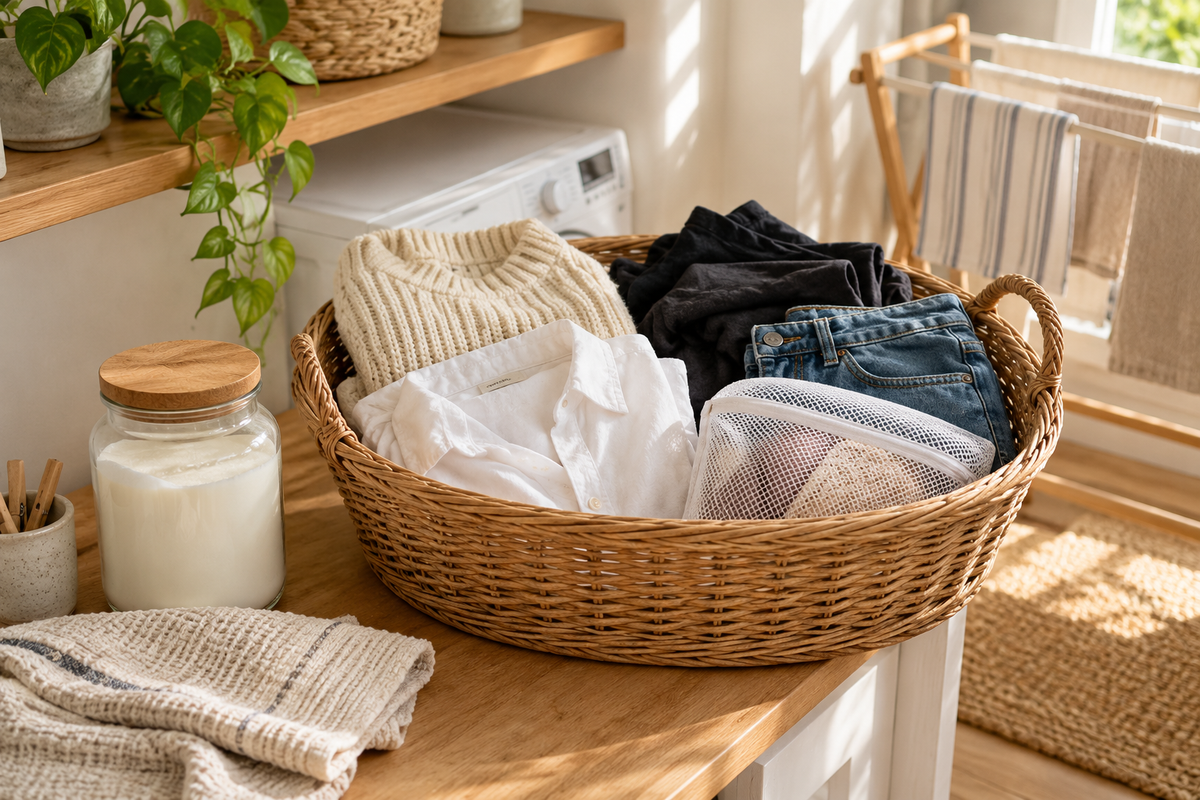
A good laundry routine is not about washing everything more often. It is about making five decisions before damage happens: what belongs together, what needs treatment, which wash method the label permits, which pieces need protection and how each item should dry.
Use a simple sequence: SORT + INSPECT → TREAT → WASH → PROTECT → DRY + RESET. Sort by care need rather than color alone, check stains before washing, measure one suitable detergent, contain compatible vulnerable pieces and separate air-dry or flat-dry items before the washer starts.
The simple laundry routine
The most useful routine starts before laundry day. When ordinary clothes, light items and special-care pieces have distinct places, you can see when a real load is ready. You do not need a three-bag cart to do this—a hamper plus a two-minute sort works for a small wardrobe—but the categories should stay clear.
The routine ends later than many people think. Moving clothes from washer to dryer is not completion. The cycle is finished when everything is dry, folded or hung, and returned to its place.
Read the care label before choosing the cycle
The label sets the safe boundaries for washing, bleaching, drying and ironing. If a symbol is unfamiliar, use the Laundry Care Symbols guide before selecting the default cycle. This is especially important for drying: the garment may be washable but still require low heat, air drying or flat drying.
1. Sort by care need, not color alone
Color is one factor, but fabric, construction, soil level and the care label matter just as much. First separate ordinary machine-washable clothes from special-care items. Then split lights and darks when dye transfer is a realistic concern or the labels call for different temperatures.
Empty pockets and check every label. Close zippers when appropriate, fasten hooks that could catch, and remove detachable pieces when instructed. Turn dark, printed or embellished items inside out only when their care guidance supports it.
A rigid sorter is optional. It earns its space when several people create multiple loads at once. In a small apartment, one hamper and a quick sort immediately before washing may be better.
2. Check and treat stains before heat
Inspect collars, cuffs, underarms and visible spills while the garment is dry. Treat only the marked area with a product compatible with that fabric, following both the product timing and garment label. Test a hidden area when instructed.
Do not combine random cleaning products or assume stronger is safer. Different marks and fibers behave differently, and aggressive brushing can disturb a fabric. A valuable piece, unknown fiber or difficult stain may need professional care.
Keep treatment beside the hamper. A small clip on the garment can remind you which spot needs attention before it enters the machine.
3. Choose one everyday detergent route
Most households do not need several overlapping everyday detergents. Choose one that suits the washable clothes you own, measure it according to the label and adjust only when the product instructions or machine guidance require it. More detergent does not automatically mean cleaner clothes.
A delicates detergent makes sense only if you regularly own garments whose labels permit hand washing or a compatible delicate cycle. It does not make every delicate-looking garment washable. “Dry clean only” remains a boundary.
4. Protect vulnerable pieces without treating the bag as permission
Mesh wash bags can contain lingerie, hosiery and small items, reduce tangling and keep hooks away from other clothes. Use the right size and avoid stuffing the bag too tightly.
A wash bag does not change the care label. It cannot make a hand-wash-only or dry-clean-only item safe for a machine cycle. Think of it as organization, not an all-purpose shield.
5. Decide how everything will dry before washing
Pull out flat-dry and air-dry items before the load starts so they do not enter the dryer by habit. Follow each garment label for temperature and method. High heat is not the default for every fabric.
For tumble-dry items, use the lowest effective setting permitted by the label and remove clothes when dry. Dryer balls are optional. For sweaters labeled to dry flat, support and reshape the garment instead of hanging its wet weight from the shoulders.
The dedicated Sweater Care guide explains the separate wash, reshape, flat-dry and storage decisions for knitwear.
Choose your laundry routine
Tap one choice below. We’ll open the matching version of the Simple Laundry Routine System.
-
Weekly laundry
Choose this if you wash normal everyday clothes each week.
-
Small space
Choose this if you use one hamper or have limited room for drying clothes.
-
Delicates first
Choose this if you often wash sweaters, lingerie or other special-care clothes.
What happens next? Your choice opens the full System, where you can select products and save your routine.
The MAREYN Simple Laundry Routine System
Choose the setup that reflects your space and wardrobe: a complete weekly routine, a small-space minimal version or a delicates-first route. Each variation uses the same five decisions while products change only where they perform a real job.
How often should you do laundry?
There is no universal day count. Wash when you have a correctly sized load, when an item’s soil level requires it, or when delaying would allow a mark or odor to settle. Avoid tiny default loads, but do not overload the drum to postpone a cycle.
Use one or two predictable laundry windows. A small household may need one main wash plus a separate special-care session. The useful schedule is the one that gets clothes fully put away.
What should be washed separately?
- Items whose labels require a different method or temperature.
- New or strongly dyed pieces when color transfer is a concern.
- Heavily soiled items that could redeposit dirt.
- Lint-producing items when lint transfer matters.
- Special-care garments needing hand washing, a delicate cycle or professional cleaning.
This does not mean every category needs a half-empty cycle. Wait for an appropriate load or handle the few special pieces separately.
A realistic small-space laundry setup
Keep it compact: one hamper, one everyday detergent, one compatible stain treatment, one or two mesh bags and a place to air- or flat-dry pieces. Store products together and keep enough clear space to fold or sort.
If clean laundry stalls, reduce load size until it can be folded in one short session. The Weekly Wardrobe Reset gives you a fixed moment to return strays, check the hamper and prepare the week.
What you can skip
- A detergent for every fabric when labels do not require separate routes.
- Scent boosters as a substitute for correct washing and full drying.
- Fabric softener on every load without checking compatibility.
- Decanted displays that hide dosage and safety information.
- Separate baskets for categories that never create a load.
- High heat simply because it finishes faster.
Common laundry mistakes
- Reading care labels after something changes shape.
- Mixing every item into one default cycle.
- Forgetting stain-treatment timing.
- Pouring detergent without measuring.
- Overfilling mesh bags or the washer.
- Letting air-dry items enter the dryer by habit.
- Leaving clean clothes in a basket.
How this fits into a longer clothing-care routine
During a seasonal wardrobe transition, wash or professionally clean items before storage, complete small repairs and store only fully dry garments. Shoes need different material-specific methods; use the Everyday Shoe Care guide instead.
Products are replaceable tools, not the structure. The lasting habit is the sequence: sort, treat, wash, protect, dry and reset.
Frequently asked questions
Do I need to separate lights and darks?
Separate them when color transfer is a concern or labels require different wash conditions. Fabric, soil and permitted temperature matter too.
How much detergent should I use?
Use the amount on the detergent label for the load size, machine type and soil level. Do not pour by eye.
Are mesh bags safe for every delicate item?
No. They contain compatible machine-washable items but do not override hand-wash-only or dry-clean-only instructions.
Should I use a dryer sheet or fabric softener?
Only when product and garment guidance support it and it solves a real problem. It should not be automatic.
How do I stop clean laundry from piling up?
Use a load size you can fold or hang in one session and define finished as returned to the wardrobe, not merely dry.
Frequently asked questions
Do I need to separate lights and darks?
Separate them when color transfer is a concern or their care labels require different wash conditions. Fabric, soil level and permitted temperature also matter.
How much detergent should I use?
Use the amount on the detergent label for the load size, machine type and soil level. Do not pour by eye.
Are mesh bags safe for every delicate item?
No. They can contain compatible machine-washable items, but they do not override hand-wash-only or dry-clean-only instructions.
How do I stop clean laundry from piling up?
Use a load size you can fold or hang in one session and define finished as returned to the wardrobe, not merely dry.