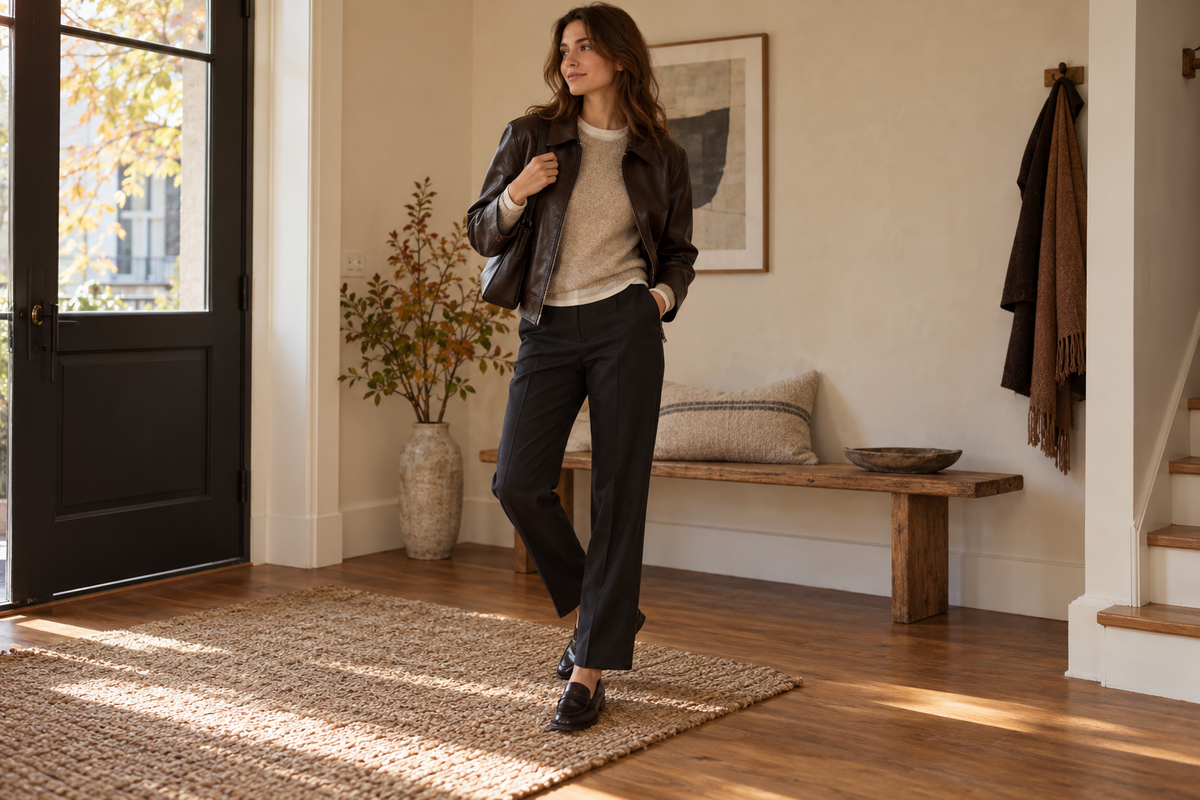
Layering should make an outfit more useful, not turn every part of it into the thickest part. The easiest way to avoid bulk is to give each layer one job: a smooth base, one flexible mid layer and an outer layer with enough room—then use the bottom and shoe to balance the combined volume.
Layer from lightest to heaviest, keep at least one top layer streamlined, vary the lengths slightly and let only one or two edges show intentionally. If the jacket pulls at the shoulders or cannot close over the mid layer, the problem is fit—not your body.
The six-part layering formula
BASE → MID LAYER → OUTER LAYER → BOTTOM → SHOE → FINISH
This is an outfit formula, not a rule that requires six new purchases. Most wardrobes already contain the necessary roles. The System helps you choose which pieces work together and shows where one missing function—not another duplicate—might improve the outfit.
Start with a base that moves under other clothes
A useful base layer is smooth enough to sit under the next piece without bunching at the sleeve or waist. It can be a tee, tank, fitted long-sleeve top or lightweight shirt. It does not need to be compressive or skin-tight; it needs to let you move and support the temperature you expect.
If the neckline or hem will show, treat that edge as part of the outfit. A white tee beneath a cream knit creates a deliberate light outline. A dark fitted top under a dark jacket creates a quieter uninterrupted column.
Choose one mid layer, not three competing ones
The mid layer usually supplies warmth or texture: a lightweight sweater, cardigan, shirt, vest or sweatshirt. When it is thick or oversized, simplify the other layers. When it is thin, you have more freedom to add structure above it.
Try the outer layer over the actual mid layer before committing to the outfit. If the sleeves drag, the shoulders lift or the front pulls, switch to a lighter mid layer or a roomier jacket rather than forcing the combination.
For more sweater-specific formulas, use the confirmed Everyday Sweater Outfit guide.
Use the outer layer to define shape
The outer layer is the visual frame. A cropped jacket can return definition when the knit underneath is loose. A longer coat or rain layer can create one clean vertical line, especially when the base and bottom are similar in color.
Length matters because several hems ending at exactly the same point can form one heavy horizontal line. Small differences often look more intentional: a tee peeking slightly below a sweater, or a shorter jacket over a longer uninterrupted trouser line.
A leather jacket is particularly useful when you want structure without a formal blazer. The Leather Jacket Outfit guide shows seven ways to change its direction through tops, bottoms and shoes.
Balance the layers with the bottom
There is no universal requirement to pair a wide top with a narrow bottom. The goal is a readable silhouette. Straight jeans can anchor a relaxed knit and jacket. Wide-leg trousers can still work with layered tops when the waist, jacket length or shoe gives the outfit a clear line.
If the outfit feels shapeless, change one variable at a time: tuck or half-tuck the base, open the jacket, shorten the visible mid layer, or repeat a color from the top half in the shoe or belt.
Let the shoe carry the right visual weight
Sneakers keep layered denim outfits casual. Loafers sharpen soft knits and trousers. Ankle boots add weight beneath darker, cooler-weather layers. The shoe does not need to match the jacket, but the two should feel equally intentional.
Check the trouser hem with the chosen shoe. A hem that works with sneakers may collapse differently over a boot or expose more ankle with a loafer. Proportion is easier to solve when the shoes are on.
Finish with one useful cue
A belt, shoulder bag, scarf or jewelry can connect the colors, but layering already adds visual information. Start with one finishing piece. A brown belt can repeat the jacket or shoe; a compact bag can keep the silhouette clean; a crossbody can add function to a casual outfit.
If the outfit feels busy, remove an accessory before removing the practical layer you need for weather.
The MAREYN Everyday Layering Outfit System
Choose Light Everyday Layers, Polished Workday Layers or Cool + Rainy Day Layers. Each variation includes a complete base, mid layer, outer layer, bottom, shoe and finishing direction.
Which outfit feels most like you?
Tap one choice below. We’ll open the matching version of the The Everyday Layering Outfit System.
-
Light Everyday Layers
A white tee, light knit, cropped jacket, straight jeans and sneakers.
-
Cover-Matched Polished Layers
The closest shoppable interpretation of the editorial cover: white long-sleeve base, oatmeal sleeveless knit, brown moto jacket, black tailored trousers, black leather loafers…
-
Cool + Rainy Day Layers
A fitted base, casual sweatshirt, light weather layer, wide-leg trousers and ankle boots.
What happens next? Your choice opens the full System, where you can select products and save your choices.
How to layer without looking bulky
- Use a smooth first layer rather than stacking several loose tops.
- Choose one main source of volume: the knit, jacket or trouser—not all three automatically.
- Try the outer layer over the real outfit and test shoulder and arm movement.
- Vary visible lengths slightly instead of aligning every hem.
- Open a jacket or cardigan to create a vertical line.
- Keep the color palette controlled when texture and volume are already strong.
- Put on the intended shoes before judging proportion.
Light everyday layering
Start with a light tee, add a lightweight crewneck and use a cropped jacket. Straight jeans and clean sneakers keep the combination practical. Let either the tee neckline or a small part of the hem show—not every edge at once.
The cover formula: polished neutral layers
The cover uses a light crewneck base, oatmeal sleeveless knit, warm brown jacket, black tailored trousers and black loafers. A compact dark-brown bag repeats the jacket without requiring an exact color match. The sleeveless knit is especially useful here because it adds visible texture without adding another full sleeve beneath the jacket.
The same-color strategy connects naturally to the Monochrome Outfit guide, which uses texture and proportion to keep tonal dressing from looking flat.
Cool and rainy-day layering
Begin with a fitted long-sleeve base, add one casual mid layer and finish with a light weather-resistant outer layer. Use trousers or jeans that work with an ankle boot. Avoid adding a second bulky knit unless the outer layer has genuine room for it.
Common layering mistakes
- Buying the outer layer without trying it over the intended knit.
- Using three thick layers when one warm layer would work.
- Letting every hem end at the widest point of the body.
- Adding multiple scarves, belts and bags to an already detailed outfit.
- Judging the silhouette before putting on shoes.
- Ignoring indoor temperature and ending up unable to remove a layer.
- Treating discomfort or restricted movement as a styling problem.
What you can skip
- A special “layering top” when an existing tee fits smoothly.
- A new jacket for every sweater length.
- Matching every brown or black exactly.
- A belt when the outfit already has a clear waist or vertical line.
- Extra accessories added only because the outfit has layers.
- Keeping an uncomfortable layer because it looks right while standing still.
Build the outfit from your closet first
Choose the outer layer you actually need for the weather, then work inward. Find one mid layer that fits beneath it, one base that moves easily, and a bottom-shoe pairing that creates the desired direction. Photograph combinations that work so they can be repeated.
During the Weekly Wardrobe Reset, test one layered outfit for the coming week and prepare any steaming, de-pilling or shoe care before you need it.
Frequently asked questions
How many layers should an everyday outfit have?
Use only the layers needed for temperature and the look. A base, one mid layer and one outer layer is usually enough; the formula can also work with only a base and jacket.
Should each layer be a different length?
Not dramatically. Small length differences can keep hems from forming one heavy line, but the correct relationship depends on the garments and your preferred silhouette.
Can I layer oversized clothes together?
Yes, when the pieces physically fit and one part of the outfit restores structure through length, an open front, a visible waist, a clean trouser line or a grounded shoe.
How do I know if a jacket is too tight for layering?
Wear it over the intended mid layer. If the shoulders lift, sleeves bind, closure strains or movement is restricted, choose a lighter mid layer or roomier outer layer.
What colors make layering easier?
A controlled palette of two or three related neutrals is simple, but contrast also works. Repeat at least one color in another part of the outfit so the layers feel connected.
Frequently asked questions
How many layers should an everyday outfit have?
Use only what temperature and the outfit require. A base, one mid layer and one outer layer is usually enough, and the formula also works with only a base and jacket.
Can I layer oversized clothes together?
Yes, when the pieces fit comfortably and another part of the outfit restores structure through length, an open front, a visible waist, a clean trouser line or a grounded shoe.
How do I know if a jacket is too tight for layering?
Wear it over the intended mid layer. If the shoulders lift, sleeves bind, closure strains or movement is restricted, choose a lighter mid layer or roomier outer layer.
What colors make layering easier?
A controlled palette of two or three related neutrals is simple, but contrast also works. Repeating one color elsewhere helps connect the layers.